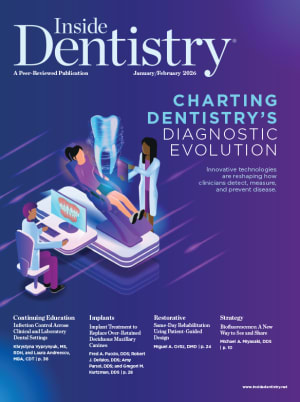
As we open a new year, our cover story offers a timely look at how diagnostic technologies are reshaping the way we see, think, and communicate in practice. AI-enhanced imaging, multimodal platforms, salivary and genetic assays, and engineering-based structural measurements are expanding our ability to detect disease earlier and more objectively. These tools do not replace our judgment, but they do sharpen it. An example of this technology is biofluorescence, described in an article by Michael A. Miyasaki, DDS, as an innovation that brings the earliest biochemical changes into view and deepens the clarity and credibility of what we share with patients.
When I consider whether to integrate any new diagnostic tool into my own practice, my priorities are simple: It must make my life easier and my care better. Technology should streamline my workflow, not complicate it. It should enhance what I already do well, not become another gadget that ends up collecting dust because it looked impressive but never fit naturally into daily use. Over the years, I’ve learned that the tools worth adopting are the ones that reduce friction, clarify decisions, and provide information I can act on immediately. When a technology strengthens the way I diagnose and plan—not just the way something looks on a screen—that’s when it earns a place in my operatory.
Beyond our diagnostics-focused features, this issue also brings practical guidance in familiar yet ever-important areas. Our continuing education article on infection control revisits the pathways of disease transmission between the operatory and the laboratory, highlighting both longstanding challenges and the growing role of technology in reinforcing safe, reliable workflows. We also present a case report detailing the multidisciplinary management of a complex anterior implant restoration in a patient with over-retained deciduous canines—a thoughtful example of planning, sequencing, grafting, and esthetic execution working together to restore a natural smile.
As we step into the year ahead, I hope Inside Dentistry inspires you to continue refining your craft, embracing new tools thoughtfully, and pursuing the kind of dentistry that makes you proud to walk into the office every day. Here’s to a year of clarity, confidence, and continued growth—in our practices and in ourselves.
Robert C. Margeas, DDS
Editor-in-Chief, Inside Dentistry
Private Practice, Des Moines, Iowa
Adjunct Professor • Department of Operative Dentistry
University of Iowa, Iowa City, Iowa